
Bicolor Angelfish
Centropyge bicolor
Also known as bicolor angel, two-colored angelfish, oriole angelfish, blue and gold angelfish, bicolour angelfish, bicolor dwarf angelfish
In other languages: 中文 双色神仙、二色刺尻鱼 · 日本語 ナメラヤッコ
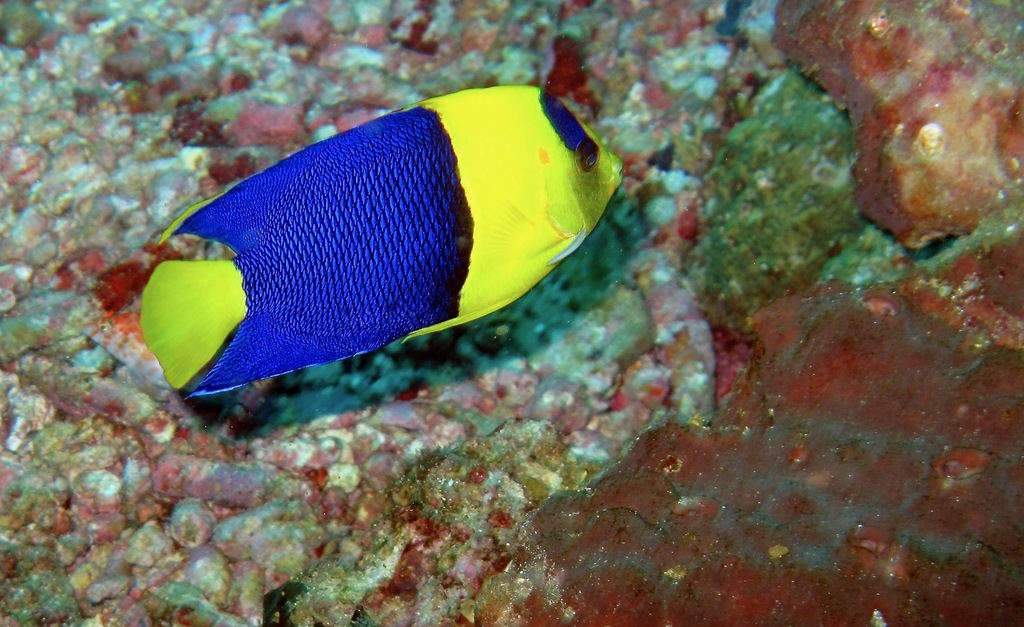
This dwarf angelfish is easy to recognise: the front half of its body is bright yellow, the rear half is deep blue, and a blue patch sits over the eye. Its strong colours and active grazing behaviour among live rock make it a popular choice for larger fish-only and reef tanks.
Care at a glance
- Care level
- Hard
- Temperament
- Semi
- Adult size
- 13 cm
- Temperature
- 24 to 27 °C
- pH
- 8.1 to 8.4
- Smallest tank
- 300 litres
- Keep as
- Keep singly, or as a male and female pair in a large tank
- Diet
- Omnivore: grazes algae and eats spirulina-based foods, mysis, brine shrimp and marine pellets
- Swims
- Middle of the tank
- Lifespan
- 5 to 10 years
- Water
- Marine (saltwater)
- Wild range
- Indo-West Pacific: East Africa to Samoa, north to southern Japan, south to Australia
Breeding
It is a protogynous hermaphrodite, so females can turn into males, and pairs spawn pelagic eggs at dusk. Spawning sometimes happens in aquariums, but raising the tiny larvae is very hard and seldom done.
Good to know
It often settles poorly after shipping, so choose a feeding specimen and give a mature tank with plenty of live rock. It may nip corals and clam mantles and is aggressive towards other dwarf angels.
More in Pomacanthidae
- Abe's angelfish Centropyge abei
- African flameback angelfish Centropyge acanthops
- Asfur Angelfish Pomacanthus asfur
- Bellus Angelfish Genicanthus bellus
- Blue Angelfish Holacanthus bermudensis
- Blue Velvet Angelfish Centropyge deborae
- Blueface Angelfish Pomacanthus xanthometopon
- Bluering Angelfish Pomacanthus annularis
Guides with this fish
Marine (saltwater) aquarium fishBlue marine fishYellow marine fishAquarium fish from Pacific